The Karaoke Night Playbook: What It Costs, What It Returns, and What Gets You Sued
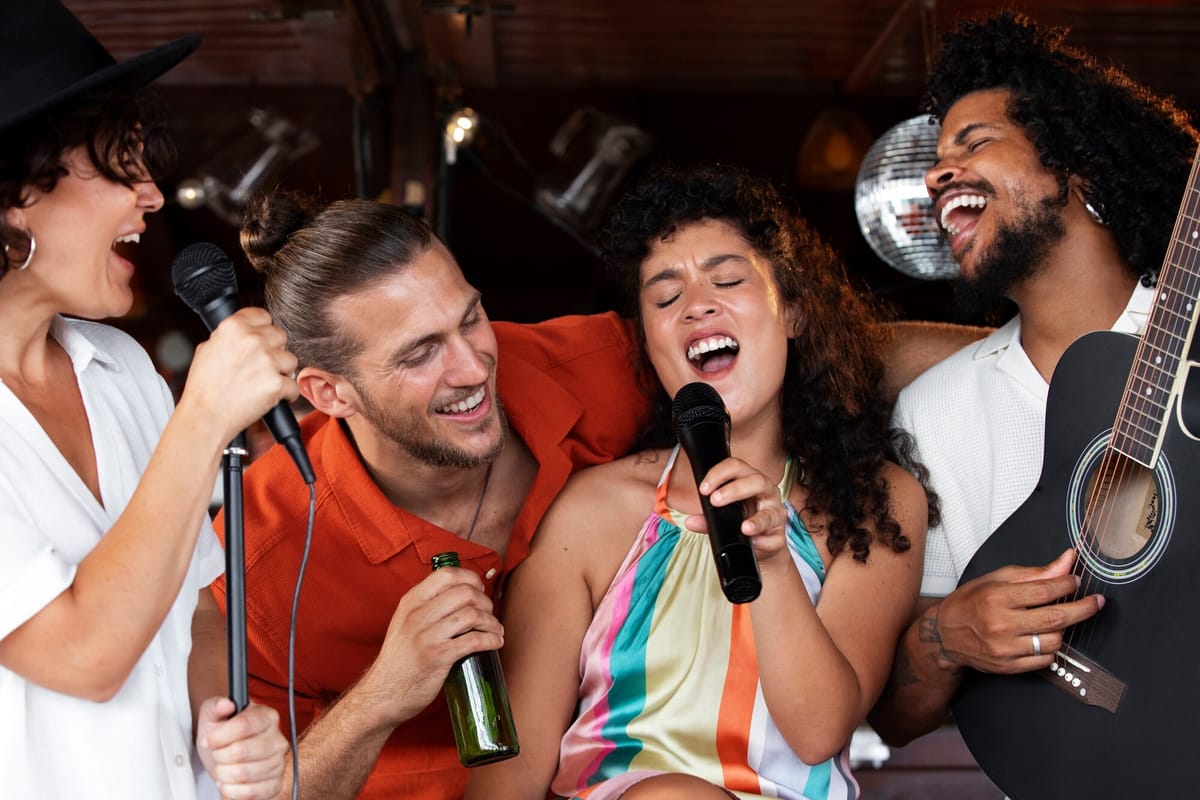
Karaoke has an image problem among operators. It reads as cheap, slightly desperate, the thing you do when the Tuesday numbers stop making sense. That reputation is mostly undeserved, and the operators who take it seriously tend to be quietly satisfied with what it does to their weeknight covers.
Here is the short version. A weekly karaoke night, run properly, is one of the cheapest recurring events you can put in a room. It costs less than a band, books more reliably than a DJ, and it produces something no other format does: people who come back next week because they want to see themselves again.
This is the operating detail behind that. Costs, margins, licensing exposure, and the specific reasons most karaoke nights die in week five.
What the format actually returns
The published numbers on weeknight entertainment are consistent in direction, if loose in methodology, and worth reading with a degree of scepticism because most of them are produced by companies selling entertainment services.
Evergreen, a hospitality software firm, reports that venues introducing weekly karaoke see roughly 15 percent monthly revenue growth, and that music trivia formats with integrated karaoke draw upwards of 70 people per event. Trivia, the closest comparable format and the better documented one, shows attendance lifts of 20 to 30 percent on slow weeknights, revenue increases in the 25 to 40 percent range, and, more usefully, 25 percent higher repeat visits from team-based formats. Ticketed comedy nights are reported to outperform regular bar sales by 30 to 50 percent on a slow weeknight.
Treat all of those as directional. The number that matters more is the one you can model yourself.
The money, worked through
Here is an illustrative model for an 80-cover neighbourhood bar running Wednesday karaoke. The assumptions are stated so you can swap in your own.
| Line | Baseline Wednesday | Karaoke Wednesday |
|---|---|---|
| Covers | 35 | 70 |
| Average spend per cover | $18 | $22 |
| Revenue | $630 | $1,540 |
| Incremental revenue | $910 |
The average spend rises because dwell time rises. People sitting through a rotation to reach their song order another round. That is the whole mechanism.
Now the cost side of the incremental revenue.
| Cost | Amount | Note |
|---|---|---|
| Beverage COGS at 22% | $200 | Toast POS data puts average pour cost at 18 to 24% |
| Host or KJ fee | $175 | GigSalad puts karaoke DJs near $475 for three hours in mid-sized US markets; a weekly residency negotiates well below one-off rates |
| Additional floor staff, 5 hours | $75 | |
| Karaoke platform, per-night share | $38 | Commercial systems run $100 to $300 per month |
| PRO licensing, per-night share | $10 | See the licensing section below |
| Incremental contribution | $412 |
Roughly $400 a night, or somewhere near $21,000 a year on a 52-week run. For a small independent bar that is not a rounding error.
Two honest caveats. First, this assumes the room fills, and it will not fill in week one. Budget to lose money for the first four to six weeks while the night builds an audience. Operators who kill a karaoke night after three quiet Wednesdays never find out whether it worked. Second, bars run 75 to 80 percent gross margins but only 10 to 15 percent net, per Toast's data, which means the incremental contribution above is meaningful precisely because the fixed costs are already paid. You are filling a room you are heating anyway.
The licensing problem, which is the part nobody explains
This section exists because the majority of karaoke content written for operators skips it, and it is the only part of the format that carries real financial risk.
Playing music in a commercial venue requires permission from the people who wrote it. Buying the song does not grant that permission. A Spotify subscription does not grant it. Your background music provider almost certainly does not cover it either, because those services license background playback, not live performance.
Karaoke requires two distinct things, and the sources contradict each other on this, so it is worth being precise.
The karaoke content itself. The backing track with the on-screen lyrics is a separate product from the original recording, and using it commercially requires a commercially licensed platform. KaraFun Business, Singa Business and Sunfly are the names that come up repeatedly. Consumer apps and YouTube do not qualify for commercial use. Expect $100 to $300 per month.
The public performance right. This is the one that catches people. In the United States that means licences from the performing rights organisations, principally ASCAP and BMI, and depending on repertoire also SESAC and GMR. ASCAP's minimum annual general licence sits around $402 in 2026, and historically smaller bars have paid somewhere between $150 and $500 per PRO per year. Some karaoke platforms market themselves as including licensing, and some operator guides repeat that claim. Verify it in writing against your specific territory before relying on it, because the general position in US law is that the venue carries the liability, not the performer and not the software vendor.
Outside the US the structure is similar but the bodies differ. The UK splits it between PRS for Music and PPL. Germany has GEMA. France has SACEM. Romania splits authors' rights and performers' rights between UCMR-ADA and CREDIDAM respectively. The principle is the same everywhere: the venue is responsible, and hiring a host does not transfer that responsibility.
The exposure is not theoretical. ASCAP sued Woody's River Roo, a 250-seat restaurant and bar near Sarasota, over songs performed by DJs, live musicians and karaoke singers without licences. US statutory damages run up to $150,000 per work for wilful infringement. That is a ceiling rather than a typical outcome, and most disputes settle far lower, but the arithmetic is unflattering when the annual licence costs roughly the same as one busy Wednesday.
Get the licences. They are cheap relative to everything else on your P&L and they remove the only genuinely bad outcome in this format.
Why most karaoke nights die in week five
The failure mode is always the same, and it is not the equipment.
A karaoke night attracts a small group of confident singers. Left alone, those eight people will sing all night, because they are the ones who keep putting slips in. Everybody else watches for forty minutes, decides the night is not for them, and does not come back. By week five you have eight regulars performing to a room that has emptied around them.
The fix is rotation discipline, and it is entirely the host's job. Cap the queue so nobody sings twice before everybody has sung once. Seed the first three slots with staff or with friends of the house so the night starts warm rather than with a long silence. Break the rotation with duets and group songs, which are the entry point for people who will never sing alone. And keep individual performances to a single song rather than letting anyone run a three-song set.
This is why the host fee is the last line to cut. A competent host manages the room, keeps the rotation moving and reads when the energy needs a fast song. An incompetent one lets the loudest table run the night. The difference between the two is roughly $50, and it is the difference between the format working and not working.
The part that turns a night into a habit
Here is the structural weakness of karaoke as a business format. It generates an enormous amount of goodwill inside the room and almost none of it leaves the building.
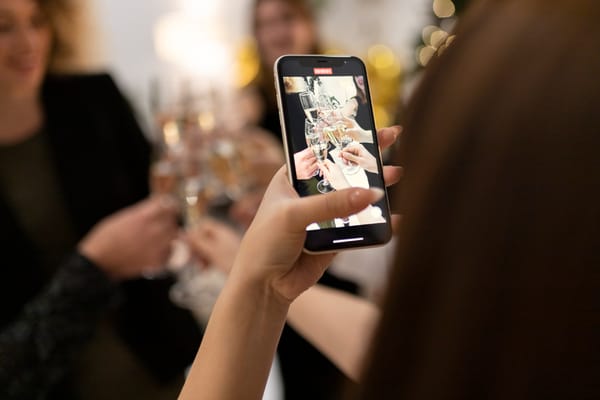
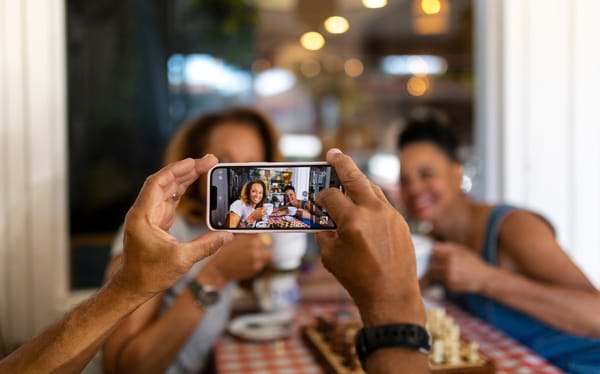
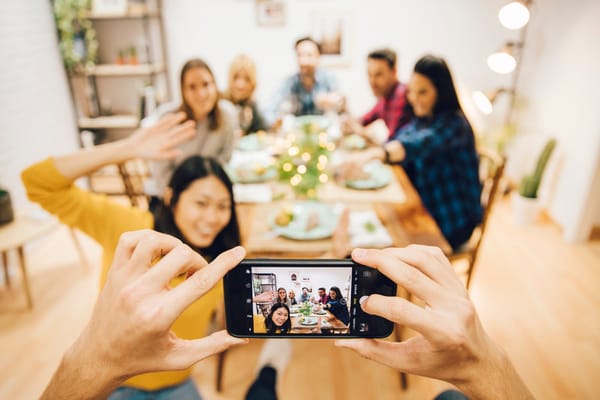
Consider what happens on a good night. Seventy people, most of them filming, produce several hundred photos and videos. Those clips go into individual camera rolls and private group chats. Some fraction reaches Instagram stories that expire in twenty-four hours and that you never see. As the venue, you end up with whatever your bar manager happened to shoot on their phone between orders, which is usually four blurry frames and nothing usable.
That matters commercially for two reasons.
The first is acquisition. Roughly 62 percent of diners check a restaurant's social accounts before deciding where to eat, and around 74 percent use social media in the decision somewhere. Guest-created content converts substantially better than brand-created content in this category. One 2026 figure, from analytics firm PostEverywhere, puts user-generated content at four times the conversion of branded photos. Your karaoke night is producing exactly the content that works and you are capturing almost none of it.
The second is retention, which is the more valuable one. People come back to see themselves. Somebody who sang badly and enjoyably on Wednesday will absolutely return next Wednesday if there is a photograph of it somewhere, and will bring the two friends who were tagged in it.
The mechanism is simple enough to run yourself. Put a QR code on the tables and by the microphone that opens a shared gallery for that night. Guests scan it and upload straight from their phone, or shoot inside it directly, and everything lands in one place. No app download, which matters, because a guest four drinks into a Wednesday is not installing software.
This is the use case JoinMyMoment was built for. One of our own users, a host in the United States, set it up on a whim for a karaoke night and described the results as mostly a collection of wild singing faces, which is precisely the point. Set up a new Moment each week, print the QR on the table cards, and by closing time you own the whole night's content in one downloadable gallery rather than a hundred phones.
Two practical notes if you do this. Display a small sign stating that photos uploaded to the gallery may be used on the venue's social channels, which is both good manners and, in the EU, the difference between a defensible position and an awkward one under GDPR. And put the QR where people already look, meaning table cards and the queue slip, not a poster by the toilets.
An eight-week launch schedule
Karaoke rewards patience more than it rewards budget.
Weeks one and two. Run it quietly. Do not advertise heavily. Book a good host, get the rotation right, and find out how the room sounds when it is half full. Expect to lose money.
Weeks three and four. Start publishing. This is when you have your own photos to post, which is far more persuasive than a graphic saying karaoke night. Post the gallery highlights on Thursday morning while people are still telling colleagues about it.
Weeks five and six. Introduce a returning reason. A leaderboard, a monthly final, a house prize for the best duet. Team formats drive repeat visits more reliably than individual ones, which is the clearest finding in the comparable trivia data.
Weeks seven and eight. Assess honestly against baseline covers, not against how it felt. If incremental contribution is positive and trending up, keep going and consider a second night. If it has flatlined, the usual culprits are the host, the rotation, or the start time.
Frequently asked questions
Do I need a licence to host karaoke in my bar? Yes, in almost every jurisdiction. You need a commercially licensed karaoke platform for the backing tracks, and separately you need public performance licences from the relevant collecting societies, which in the US means ASCAP and BMI at minimum. The venue holds the liability, not the host you hire.
How much does it cost to run a weekly karaoke night? For a small independent bar, budget roughly $175 to $250 for a host, $100 to $300 a month for a commercial karaoke platform, and a few hundred dollars a year per performing rights organisation. Equipment, if you buy rather than rely on the host's rig, runs into the low thousands.
Is karaoke more profitable than trivia? They perform similarly, and trivia is the better documented of the two. Trivia hosts cost slightly less, at a 2026 market rate of $150 to $350 a night. Karaoke tends to produce longer dwell times and more shareable content. Several operators run both, on different weeknights.
How long before a karaoke night becomes profitable? Plan for four to six weeks of building. Most nights that fail are killed before they were ever given the chance to establish as a habit.
How do I get guests to share photos from the night? Give them one place to put them and remove every step you can. A QR code on the table that opens a shared album, with no app to install, is the version that works. Create a free Moment on JoinMyMoment and test it on your next event night.
Sources: Evergreen bar entertainment analysis; Toast POS bar margin and pour cost data; CheapTrivia 2026 host rate survey; GigSalad 2026 karaoke DJ pricing; ASCAP published licensing guidance and 2026 fee data; musicforbusinessfinder karaoke licensing guide; Associated Press and Fox News reporting on ASCAP v. Woody's River Roo; PostEverywhere 2026 UGC conversion data; Restroworks restaurant social media statistics. Several sources cited here sell services to the venues they write about, and we have flagged those in the text. Licensing requirements vary by territory and this article is not legal advice.